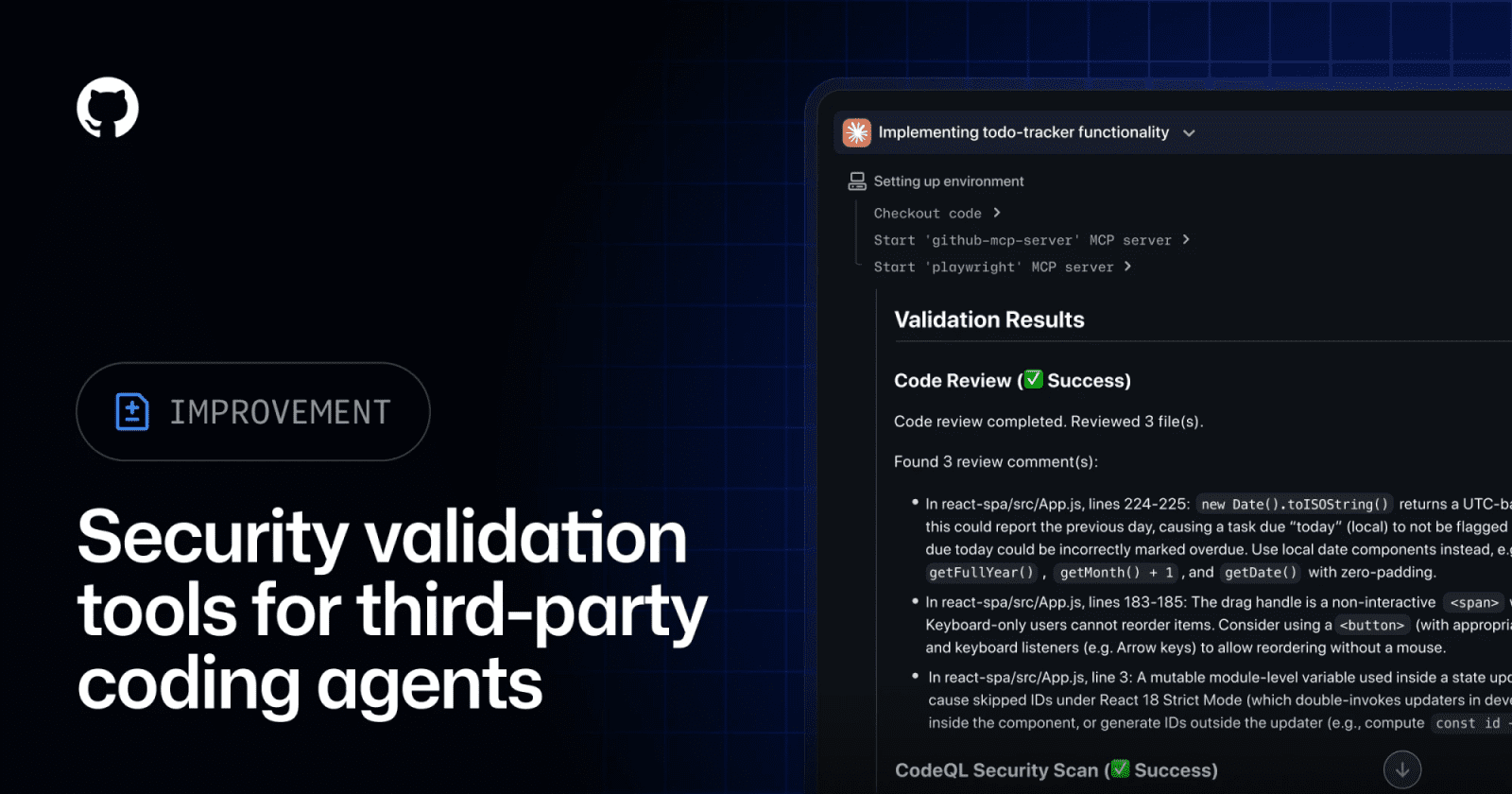
GitHub Security Validation Now Covers Third-Party Coding Agents


GitHub now applies CodeQL, dependency advisory checks, and secret scanning to pull requests created by third-party coding agents, extending protections that were already available for Copilot cloud agent.
GitHub security validation for third-party coding agents is now generally available. The change means code created by agents such as Claude and OpenAI Codex inside GitHub repositories receives automatic checks for CodeQL findings, risky new dependencies, and exposed secrets before the agent finalizes its pull request. The practical query is simple: teams using repository-based coding agents now need to inspect the validation results and policy settings, not just the agent's diff.
Key takeaways
- GitHub says third-party coding agents now receive the same automatic security validation already used for Copilot cloud agent.
- The validation stack includes CodeQL, GitHub Advisory Database checks for newly introduced dependencies, and secret scanning for API keys, tokens, and other sensitive strings.
- GitHub says the checks are on by default and follow the repository's Copilot validation settings.
- GitHub Docs still recommend human review before merging agent-authored pull requests, plus workflow and branch controls around agent activity.
- The feature does not remove the need for repository policy, but it gives teams a default safety net for agent-created pull requests.
Practical LinkLoot angle
This is useful for teams testing multiple coding agents in the same repository. Instead of building one review checklist for Copilot and a separate one for partner agents, use GitHub's validation layer as the common baseline and add repository-specific gates on top.
| Area | What GitHub now checks | What teams still decide | Source |
|---|---|---|---|
| Code security | CodeQL analysis on agent-generated changes | Which languages and rules need extra coverage | GitHub Changelog |
| Dependencies | New dependencies against GitHub Advisory Database | Whether medium-risk or license issues require separate gates | GitHub Changelog |
| Secrets | Secret scanning for tokens and API keys | How to rotate anything already exposed outside the pull request | GitHub Changelog |
| Merge control | Agent output remains subject to review and repository rules | Who can trigger agents, approve workflows, and merge | GitHub Docs |
For a practical rollout, start with low-risk repositories where agents already create pull requests. Confirm that validation is visible in the agent session or pull request checks, then add branch rulesets for areas where an automatic fix attempt is not enough. Configuration files for agents, MCP servers, and workflow permissions deserve CODEOWNERS coverage because they change what the agent can see or do.
What to verify before you act
Check whether your repository's Copilot settings enable the validation tools you expect, because GitHub says third-party agents follow those settings. Confirm the exact agent entry points your team uses: issues, pull request comments, mobile, and the Agents tab can have different operational habits even when the same validation layer applies. If your agent can use MCP tools or external services, separately review those permissions; security validation of the generated code is not the same thing as runtime control over the agent's tool access.
Source check
The GitHub Changelog confirms the general availability announcement, the third-party-agent scope, and the CodeQL, dependency, and secret-scanning checks. GitHub Docs confirm the broader Copilot cloud agent mitigations, including human review, workflow controls, branch restrictions, and the claim that security validation does not require a GitHub Advanced Security license.
GitHub says third-party coding agents, including Claude and OpenAI Codex, now receive automatic security validation when they create code in repositories.
For adjacent workflow ideas, see LinkLoot's guide to AI agent tools.
Try the related loot
UI-TARS Desktop is a serious local computer-use agent — if you lock down the setup