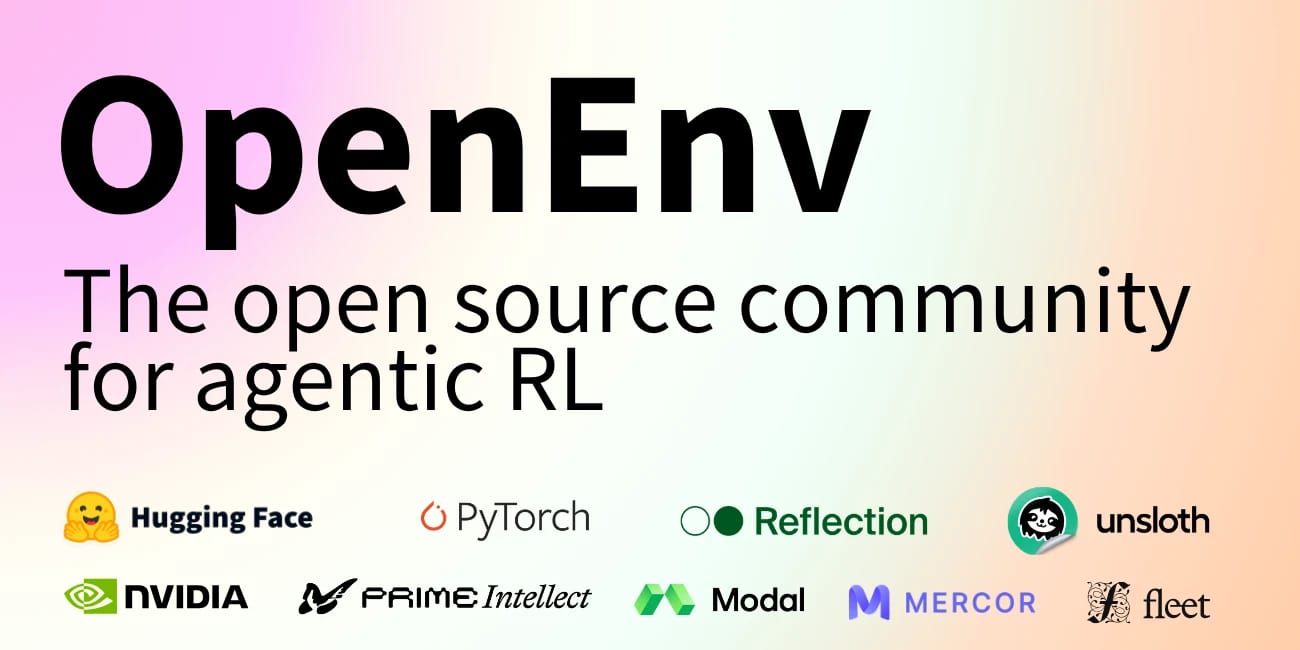
OpenEnv gets broader open-source backing for agentic RL environments


Hugging Face says OpenEnv is moving under broader open-source coordination, positioning it as a protocol layer for agentic reinforcement learning environments.
Hugging Face says OpenEnv is now coordinated by a broader technical committee and positioned as an interoperability layer for agentic reinforcement learning environments. The project is meant to standardize how environments are published, deployed, and consumed by agents, rather than define reward functions or training loops. The OpenEnv docs describe it as a unified framework for isolated execution environments with Gymnasium-style APIs, container packaging, HTTP services, and sandboxed execution.
Key takeaways
- OpenEnv now lives at the
huggingface/OpenEnvrepository and is being coordinated by a committee that includes Hugging Face, Meta-PyTorch, Reflection, Unsloth, Modal, Prime Intellect, Nvidia, Mercor, and Fleet AI. - The project focuses on an interface layer for agent environments, not on replacing reward libraries or training frameworks.
- OpenEnv environments expose familiar
reset(),step(), andstate()patterns. - The docs emphasize container packaging, HTTP services, sandboxed execution, and pre-built environments for tasks such as games, coding, and web browsing.
- The project remains experimental, so API stability and environment quality need close review before production use.
Practical LinkLoot angle
OpenEnv matters for teams trying to train or evaluate agents against realistic tool environments without rewriting integration code for every harness. If the project matures, a trainer could speak one environment interface while the underlying task runs as a browser, terminal, game, code repo, or MCP-compatible service.
| Option | Best use | Limitation | Source |
|---|---|---|---|
| OpenEnv | Standardizing agentic RL environments across trainers and harnesses | Experimental stage, with possible API changes | Hugging Face Docs |
| Custom one-off environments | Fast prototypes for a single agent stack | Harder to reuse across trainers or evaluation setups | LinkLoot analysis |
| MCP-compatible environments | Reusing tool interfaces between simulation and production modes | Requires careful lifecycle and permission design | Hugging Face Blog |
The practical move is to treat OpenEnv as infrastructure to watch and test, not a plug-and-play production standard yet. It is most relevant for teams building agent benchmarks, environment hubs, or training loops where consistent task packaging matters more than a single demo score.
What to verify before you act
Check the repository activity, release notes, and docs before adopting OpenEnv in a training pipeline. Confirm whether the environment type you need already exists, whether it can run in your sandbox model, and whether your trainer supports the required protocol. If you are evaluating tool-using agents, verify that rewards, tasksets, and logs are defined outside the environment interface clearly enough to reproduce results.
The Hugging Face announcement confirms the governance shift and protocol-layer framing. The OpenEnv docs corroborate the framework goals, Gymnasium-style API, container-first deployment, HTTP service model, and experimental status.
Useful next steps
Use OpenEnv first in a throwaway benchmark or eval harness, then compare the setup cost against your current custom environment code. Track whether tasksets, external reward integration, and harness support land as planned. For broader agent-stack research, pair this with LinkLoot's AI agent tools guide and AI workflow automation guide.
OpenEnv is an open-source framework for creating, deploying, and using isolated execution environments for agentic reinforcement learning.
Try the related loot
UI-TARS Desktop is a serious local computer-use agent — if you lock down the setup