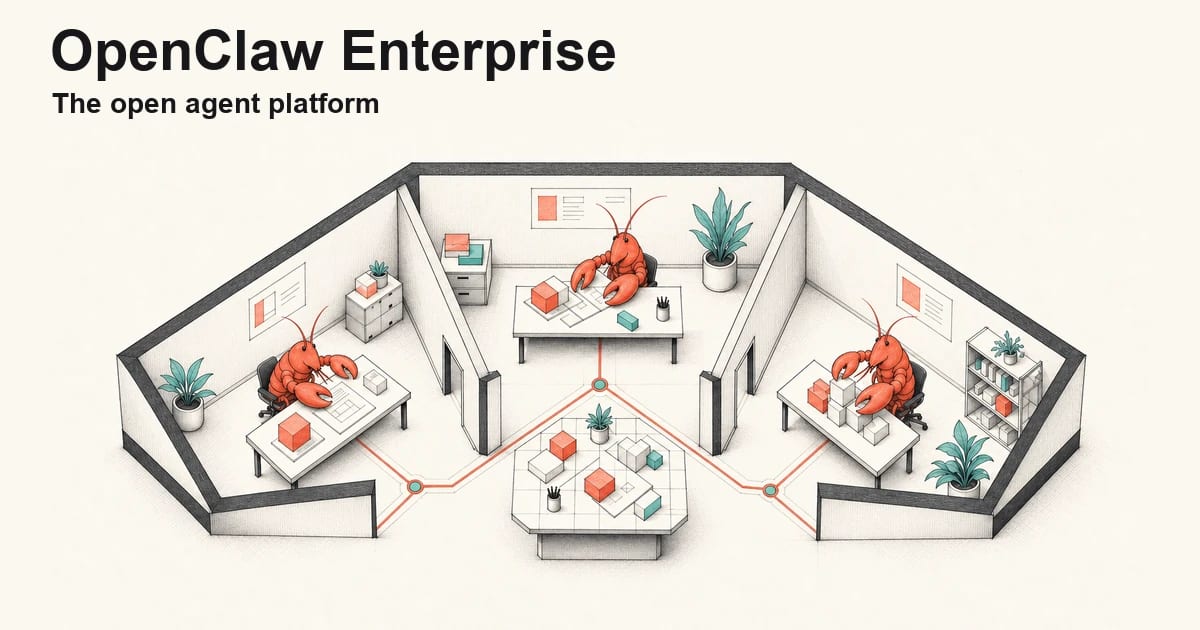
OpenClaw Enterprise adds an open control plane for persistent agents


OpenClaw Enterprise moves persistent agents toward centrally governed team deployments. The project is free to use, but still pre-1.0: current documentation separates working Kubernetes capabilities from security features that remain planned.
OpenClaw announced OpenClaw Enterprise on September 29 as an open control plane for persistent agents. For teams, the useful change is less about another chatbot and more about who can deploy agents, which resources they can access, and how their work is governed. The project remains pre-1.0 and is positioned for internal pilots, not as an automatic production-safety guarantee.
A control plane, not just another agent chat
The architecture separates platform management from agent execution. OpenClaw Control Plane manages deployment state, authorization and resource lifecycles; individual agent runtimes handle conversations and tools. Its implemented components include an API, console, durable worker, PostgreSQL persistence and Kubernetes packaging. The architecture overview distinguishes those components from approved designs that have not yet become supported features.
That distinction changes how to evaluate the project. A successful chat response is one test; correctly scoped deployment permissions and predictable lifecycle operations are different tests. Treating all three as the same thing would miss the point of a control plane.
Red Hat confirms the collaboration separately
The announcement says the project originated at OpenAI, moved to the independent OpenClaw Foundation, and was developed with Red Hat and NVIDIA. OpenClaw says it will remain free for organizations to use. Free platform software does not remove the cost of infrastructure or inference.
Red Hat's September 29 post independently confirms work on the new enterprise control plane and collaboration with NVIDIA and the broader community. It describes engineering investment in Linux, Kubernetes, distributed systems, security and infrastructure, alongside plans to orchestrate internal agent deployments. That is a useful second organizational source, rather than another copy of the same social post.
Red Hat connects this effort to a familiar open-source pattern: shared upstream engineering around a foundation that different vendors and operators can build on. Its stated interest is making persistent agents manageable across users and teams, not merely adding a polished interface to an individual assistant.
The working security boundary has limits
Dedicated Kubernetes execution separates gateway and harness namespaces, identities and storage. However, the current implementation notes list external access-gateway admission, workload authentication to the control plane and general credential-free inference as planned work. They also distinguish namespace separation from node isolation, which requires operator-configured placement.
For an evaluation, that suggests a concrete question: which boundaries does this exact deployment enforce today? An architecture diagram or an open-source repository is not evidence that every planned protection is active. This is a reading of the documented limits, not a claim that LinkLoot has penetration-tested the platform.
Local setup is more than a Compose preview
The current local guide uses k3d Kubernetes for the control plane, PostgreSQL and agent workloads. It requires a container engine, Kubernetes tooling and build dependencies, and calls for about 20 GB of container-engine storage for the initial build.
The guide explicitly selects a Kubernetes-capable profile. Its default Compose control-plane preview cannot deploy agents, so opening a console alone does not prove an agent deployment works. Installing the platform does not require a model credential; the subsequent first-agent walkthrough requires an OpenAI API key. These are separate milestones, not interchangeable definitions of a completed setup.
A useful first pilot stays deliberately small
Our editorial takeaway is to start with one bounded workflow and document its permissions, deployment path and failure behavior. Use the platform's current guides, not a launch graphic, as the operational reference. Keep model access and infrastructure costs separate from the software's free availability.
For related context, see LinkLoot's AI agent tools guide. The next meaningful checkpoint for OpenClaw Enterprise is the planned 1.0 release and the implementation of the remaining security contracts, not simply the number of agents a team can launch.
Try the related loot
Linkwarden: self-hosted bookmarks with page archiving