Topic
#AI Agent
Loot, blog posts and adjacent themes connected to this topic. Follow the tag to keep it in your orbit.
2Shown loot
0Shown articles
8Linked neighbor tags
Topic paths
If you want to go deeper, the adjacent tags are the fastest way to compare and branch into related workflows.
Loot
More from this topic
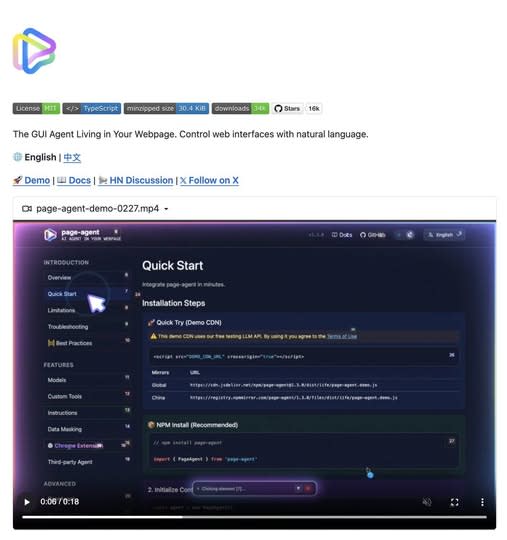
A lightweight in-page GUI agent that reads the DOM as text and executes natural-language commands inside your app. Great for copilots, form automation, and legacy UI workflows. What It Is Alibaba’s Page Agent takes a very different approach to browser automation. Instead of relying on screenshots, multimodal models, or brittle external browser control, it runs directly inside the webpage and reads the DOM as text. That means you can embed a natural-language GUI agent into your own product with a lightweight frontend integration. --- Why It Feels Different Most traditional browser automation stacks still depend on: screenshots selectors brittle scripting heavyweight orchestration Page Agent flips that model. It allows commands like: “fill out this form” “open settings” “change the billing plan” “submit the support request” And it does that inside the page context itself. --- Where It Gets Interesting The real value is not just automation. It is the ability to turn normal interfaces into natural-language workflows. That makes Page Agent especially interesting for: SaaS copilots internal tools admin dashboards form-heavy workflows support tooling accessibility layers for older web apps --- What Makes It Stand Out A lot of AI browser tools still feel like external bots driving a website from a distance. Page Agent feels closer to: an embedded UI assistant a natural-language task layer an AI control system for existing interfaces That difference matters. Because once the agent lives inside the interface, it becomes easier to imagine: product onboarding copilots guided admin actions internal ops assistants text-driven navigation for legacy tools --- Best Use Cases Use case Why it fits --- --- SaaS copilots Lets users control complex interfaces with natural language Internal tools Great for repetitive admin or ops workflows Form automation Especially useful where users need help completing multi-step UI flows Legacy software Adds a modern interaction layer without rebuilding the whole interface Accessibility Makes web apps easier to navigate through voice or text --- Why This Could Matter More Than It Looks A lot of people will see this and think: “Cool, another browser automation project.” That undersells it. What makes this interesting is that it points toward a broader shift: from external automation to embedded natural-language interaction If that model keeps improving, products will not just have dashboards anymore. They will have interfaces that users can talk to. --- Final Take Page Agent is one of the more interesting examples of where AI product interfaces are heading. Not because it is flashy. But because it suggests a practical future where: interfaces remain visual users stay inside the product and AI becomes a task layer sitting directly on top of the UI That is a much stronger idea than “just another browser bot.” Source GitHub: https://github.com/alibaba/page-agent
- LinkLoot access
- Free
- Provider costs
- Unknown
Review open

Text: AI-generated
AI-generated · Automatically published by LinkLoot. RemainderBot spends leftover AI subscription quota on finished pull requests in your own private repo, with merge or close as feedback. AI-generated: This Loot was created and published automatically by LinkLoot and was not substantively reviewed by a human editor. What it does RemainderBot watches the weekly quota clock on a Claude Code or Codex CLI subscription. When an hourly cron job sees that the reset is less than four hours away and at least 10% of quota remains, it kicks off a run. The agent reads task lists, issues, docs, and notes from configured sources plus a GOALS.md file you write, picks one unfinished task, commits a plan, then builds against a deadline sized to the remaining quota. Output is a document, a tested feature, or a prototype, delivered as a pull request in a dedicated private GitHub repo. Merge counts as approval; closing with a comment feeds the next run's selection logic. Who it helps Developers who pay for Claude or Codex subscriptions but regularly leave quota unused at week's end. It suits solo builders or small teams that keep project state in plain text files and want finished work rather than chat transcripts. Runs land in your own repo, so nothing touches shared infrastructure without your review. Getting started You need a dedicated machine such as a small VPS, Python 3.11 or newer, git, and the GitHub CLI (gh). Install either Claude Code or the Codex CLI (or both), logged in with an active subscription. Clone the repository directly rather than forking: forks of public repos cannot be made private, and template copies create merge conflicts on updates. Create a private repo from the clone, copy sources.example.toml to sources.toml, edit GOALS.md and the source config, then commit and push. The bot generates its own inbox and state files. If you use Google Workspace sources, install the gws CLI separately. Limits and costs The software itself is MIT-licensed open source, but running it requires a paid Claude or Codex subscription and hosting on a machine you control. Every instance must stay private because each run branch embeds a copy of everything the agent read along with its full log. The design runs the agent with permission checks disabled on the dedicated box, treating that machine as the sandbox. Finalize passes can only cut scope, never add features. Pricing beyond the underlying subscription is not specified by the project documentation. Source links Official repository Project documentation MIT license
- LinkLoot access
- Free
- Provider costs
- Unknown
Review open
Blog
Related reads
No blog posts for #AI Agent yet
There is no published article with this tag right now. Browse the blog for adjacent themes or follow the tag for future updates.