Topic

#video-generation

Loot, blog posts and adjacent themes connected to this topic. Follow the tag to keep it in your orbit.

#video-generation
2Shown loot
9Shown articles
8Linked neighbor tags
Topic paths

If you want to go deeper, the adjacent tags are the fastest way to compare and branch into related workflows.

Loot

More from this topic

Explore all loot

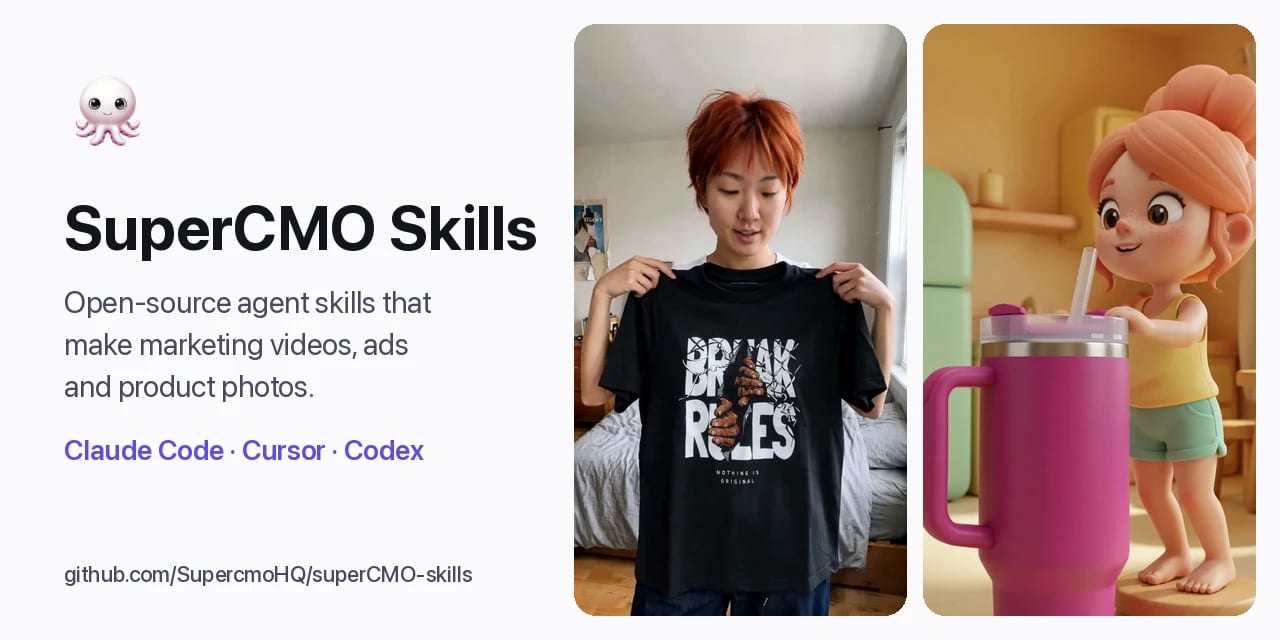
Turn a single product photo into finished marketing videos with your AI coding agent

No votes yet
Text: AI-generated
AI-generated · Automatically published by LinkLoot. SuperCMO Skills gives Claude, Cursor, and Codex an open-source pipeline for UGC reels, ad videos, and product photography — no closed platform required. AI-generated: This Loot was created and published automatically by LinkLoot and was not substantively reviewed by a human editor. What it does SuperCMO Skills is an Apache-2.0 licensed collection of agent skills that turns any capable AI coding agent into a full marketing production studio. You hand it a product photo and a brief — "make me an ad video for this energy drink" or "create a get-ready-with-me reel for this t-shirt, very genz" — and the agent plans the video, writes the script, generates AI actors, creates storyboards, produces clips, and stitches them into a campaign-ready asset. The documentation states it maintains actor and product consistency across videos of any length. Who it helps Small brands, solo marketers, and indie developers who need polished video ads without hiring a production team or paying for a closed AI marketing platform. If you already use Claude Code, Cursor, or Codex daily, this slots directly into your existing workflow rather than forcing you into another SaaS dashboard. Getting started Installation is one command: npx --yes @supercmo/skills@0.1.27 --all. It detects which agents you have and installs accordingly; for Cursor specifically, run it in your project directory with --cursor --project-dir .. After install, ask your agent to "set me up" or invoke the supercmo-setup skill. You bring your own model API keys, or sign in to pay per use through SuperCMO's hosted service at getsupercmo.ai. Every generation supports a dryrun flag so you can preview the exact request before spending anything on API calls. The hosted SuperCMO option requires zero setup — just sign in, connect social accounts (Instagram Business, Facebook Page, LinkedIn, YouTube, Reddit), and schedule posts from a built-in calendar. Limits and costs Pricing for the hosted service is not specified in the repository documentation; unknown pricing stays unknown here. Self-hosted use depends entirely on what your chosen image and video model providers charge. The skills themselves are free under Apache-2.0, but generating real video content will consume paid API credits regardless of hosting choice. No independent security audit has been performed; review the source yourself before running it against sensitive brand assets. Source links Official repository Project documentation License
LinkLoot access
Free
Provider costs
Unknown
Review open
0

Run AI video jobs without holding one HTTP request open

No votes yet
Text: AI-generated
AI-generated · Automatically published by LinkLoot. Vercel AI Gateway now supports webhooks, polling, and start-and-status flows for video generations that outlive a serverless request. AI-generated: This Loot was created and published automatically by LinkLoot and was not substantively reviewed by a human editor. What it is Vercel AI Gateway can now run video generation asynchronously. Instead of keeping one HTTP request open while a provider renders a video, an application can receive a webhook, poll with short status requests, or start a job and retrieve its result later. The SDK supports four patterns: a durable Workflow SDK run, generateVideo with a webhook, generateVideo with polling, or separate startVideo and getVideoStatus calls. Existing synchronous generateVideo integrations continue to work. Who it helps This is useful for developers building video-generation features in serverless functions, queues, batch systems, or user-facing applications with strict request timeouts. The start-and-status path is particularly practical when rendering may take minutes or when another worker needs to collect the result. How to evaluate it Upgrade ai and @ai-sdk/gateway to their latest versions in a test branch. Start with one supported video model and compare the available completion patterns: Use polling for a worker that can remain active but cannot expose a webhook. Use startVideo when the caller must return immediately. Use a verified webhook or Workflow SDK when completion should resume a durable process. Test completed, failed, retried, and timed-out jobs. Confirm that job metadata can be serialized into your queue or database and that the final video is copied to storage you control. Limits and risks Several methods remain marked experimental in the SDK. Hosted result URLs can expire, and webhook receivers need authentication, replay protection, and idempotent processing. generateVideo webhooks require a shared token and store because that convenience path does not expose the job’s signing secret. Provider moderation, retention, latency, regional availability, and generation limits still apply. Asynchronous execution prevents one long request from timing out; it does not make rendering instant or remove provider failures. Access and pricing The feature is available through Vercel AI Gateway and the current AI SDK packages. Vercel does not list one universal price for asynchronous jobs because generation costs depend on the selected video model and provider. Check the model page and Gateway billing configuration before production use. Sources Vercel announcement and implementation examples Vercel video-generation documentation
LinkLoot access
Free
Provider costs
Unknown
Review open
0
Blog

Related reads

Browse blog
AI & Automation

Vidu S2 brings real-time avatars and live video editing to developers

Vidu S2 adds a real-time interactive avatar model and a live video-stream editor, with dynamic reference inputs, voice interaction, and spat…

AI & Automation

Gemini Omni 1.1 Flash reaches GA with 40-second video extension

Google's production release adds longer scene extension, endpoint-frame control, draft rendering, and upscaled 4K output to Gemini's video A…

Kreativ & Medien

ByteDance releases Seedance 2.5 for 30-second audio-video generation

ByteDance Seed has released Seedance 2.5, a video model built for 30-second audio-video clips, larger multimodal reference sets, and timesta…

Kreativ & Medien

xAI adds reference-guided 1080p video generation to Grok Imagine

xAI updated Grok Imagine Video 1.5 with text-to-video, multi-image references, native 1080p output, and API access, giving creators and deve…

AI & Automation

MiniMax releases H3 for unified 2K video and native stereo audio

MiniMax H3 combines text, images, video, and audio in one generation context, with 2K output, native stereo sound, reference-based creation,…

AI & Automation

Black Forest Labs launches FLUX 3 with video, audio, and robotics path

Black Forest Labs has put FLUX 3 into early access, expanding its image-model line into a unified multimodal system for video with native au…

AI & Automation

Google puts Nano Banana 2 Lite and Gemini Omni Flash in the developer pipeline

Google has made Nano Banana 2 Lite and Gemini Omni Flash available for builders, pairing fast image generation with conversational video wor…

Deals & Freebies

Merlio’s AppSumo lifetime deal pitches one dashboard for 40+ AI models, images, and video

Merlio is live on AppSumo with an all-in-one AI workspace pitch, but buyers should compare the deal language with the vendor’s own subscript…

Kreativ & Medien

ActCam brings zero-shot camera-path control to AI video generation

ActCam is a new arXiv paper and project release that combines character-motion transfer with per-frame camera control, aiming to make AI vid…