
OpenAI Maps Its GPT-6 Strategy Around Delegated Work


OpenAI says GPT-6 Astra, broader distribution, and in-house compute are converging around a larger market for delegated work.
OpenAI is positioning GPT-6 Astra as more than a model upgrade. In a September 8 strategy post, the company describes a flywheel linking frontier capability, consumer and enterprise distribution, and tighter control over compute economics. The practical consequence is a larger set of tasks OpenAI believes customers can delegate to AI, from software engineering and browser work to research and professional workflows.
OpenAI ties GPT-6 Astra to a wider work market
OpenAI calls GPT-6 Astra a major capability step and says it is state of the art in computer use, browsing, software engineering, cybersecurity, science, and professional work. The company’s strategy argument is that stronger models make previously uneconomic work worth attempting: processes that required scarce specialists may become affordable for more businesses.
TechCrunch independently reported Astra’s launch and described a staged rollout through OpenAI’s Daybreak cybersecurity program, paid ChatGPT plans, and the API. That reporting supports the launch and availability stage, while OpenAI’s newer post frames the broader business and workflow implications.
The distinction matters. OpenAI is describing a direction and operating model, not promising that every customer can immediately automate every workflow. Access, plan eligibility, task reliability, and the level of human review still depend on the product and use case.
Distribution is part of the model strategy
OpenAI says its products reach more than one billion weekly active users and 2.5 million businesses. It argues that a capability advance can move quickly across ChatGPT, ChatGPT Work, Codex, and API applications rather than waiting for a new distribution channel.
The company also cites internal usage data: people on individual ChatGPT plans sent roughly 50% more messages per day six months after signup than in their first month and tried about twice as many distinct tasks. Those figures are OpenAI’s own study, so they should be read as company-reported evidence rather than an independent market measurement.
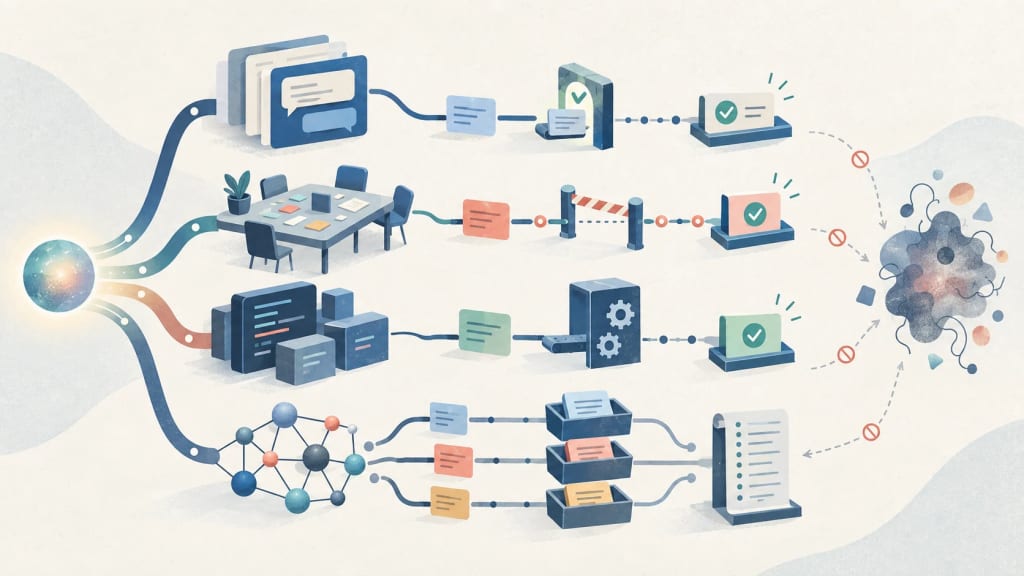
For teams, the immediate workflow question is where delegation has a clear acceptance test. Code changes, browser operations, research synthesis, and support triage can be evaluated with logs, test suites, approval gates, and rollback paths. A general promise of “more work” is less useful than selecting a bounded task with measurable output quality.
Compute economics determine how far delegation spreads
OpenAI says it is managing data centers, chips, software, models, and products as one compute strategy. It reports that GPT-5.6 Sol helped reduce production serving costs by 20%, while additional work improved token-generation efficiency by more than 15%.
The post also introduces Jalapeño, OpenAI’s first custom inference chip. OpenAI says internal InferenceX tests across three public models showed 1.5 to 1.9 times the peak token throughput per watt of the commercial systems tested, with lower end-to-end latency. The company plans to begin deploying the chip by year-end alongside NVIDIA, AMD, and other accelerators.
These are vendor-reported measurements, not a neutral benchmark. Their importance is economic: if each completed task requires fewer attempts and less serving cost, more agentic workloads can fit within a customer budget and OpenAI’s available capacity.
What builders should watch next
The next concrete signals are rollout breadth, API behavior, pricing, and production reliability. Builders evaluating Astra should verify their account’s actual access, test representative tasks, record failure and escalation rates, and keep a human approval step for consequential actions.
For implementation patterns around agents, see LinkLoot’s AI agent tools guide. OpenAI’s strategy only becomes operational value when a specific workflow can be measured end to end.
Source check
OpenAI is the primary source for the strategy, user, compute, and chip claims. TechCrunch provides independent reporting on GPT-6 Astra’s launch and staged availability. Both sources were fetched for this run; company-reported performance and usage figures remain attributed claims.
Try the related loot
Shorten URLs and manage feature requests with 1p.io API