Topic

#code-review

Loot, blog posts and adjacent themes connected to this topic. Follow the tag to keep it in your orbit.

#code-review
Loot

More from this topic

Explore all loot

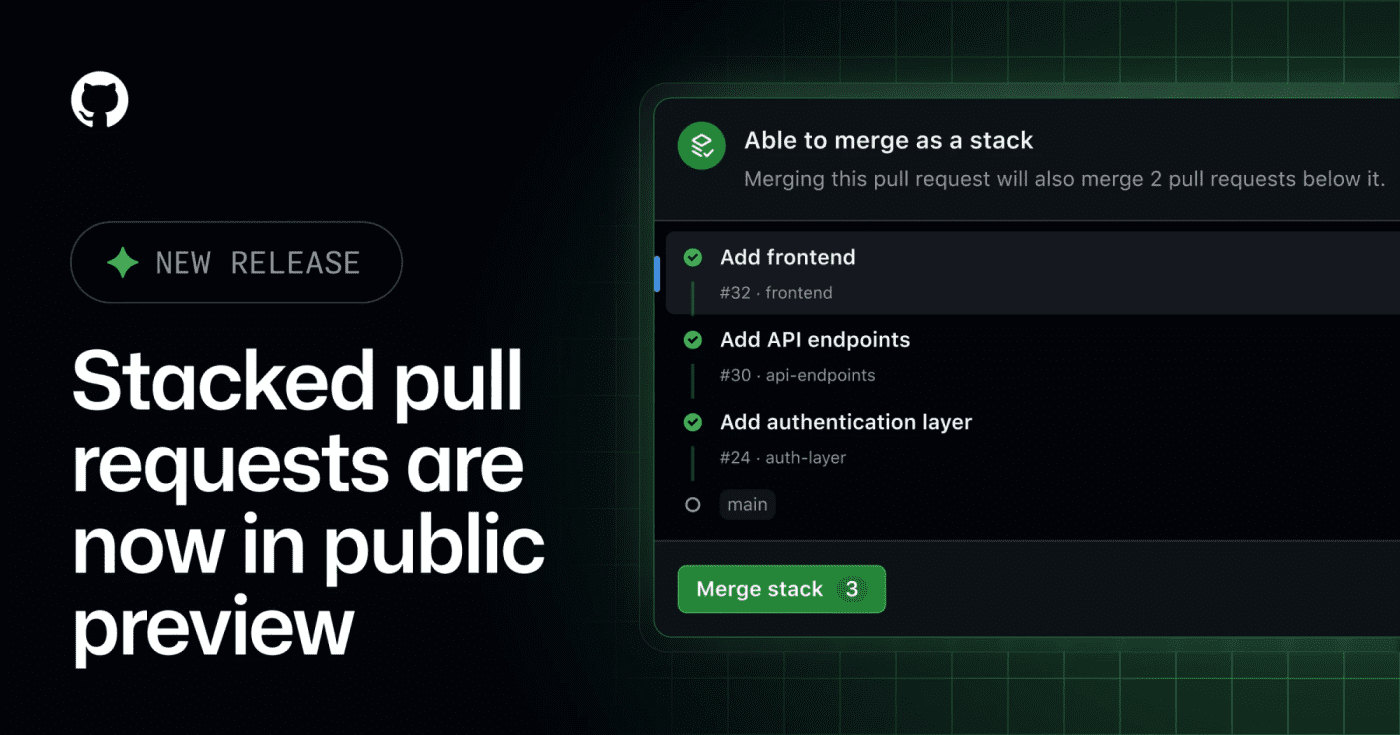
Review large GitHub changes as stacked pull requests

0
GitHub's public preview for stacked pull requests helps teams split dependent code changes into ordered, reviewable layers. GitHub has opened stacked pull requests in public preview, giving teams a native way to split a large change into smaller dependent PRs without managing the stack entirely by hand. What it is Stacked pull requests are ordered PRs where each pull request represents one focused layer of a larger change. GitHub says reviewers can inspect each layer independently, then merge the stack together when the series is ready. Who it helps This is useful for engineering teams that regularly ship refactors, migrations, feature branches with several dependencies, or AI-assisted changes that are too large for one review. It also matters for teams using Copilot workflows, because the changelog notes Copilot using a gh-stack skill in the stacked-PR flow. How to evaluate it Try it first on a non-critical branch with a small three-PR stack: setup, implementation, and tests. Check how status checks, review comments, rebases, branch protection, and merge order behave in your repository before making it part of your default review workflow. Limits and risks This is a public preview, so workflows may still change. Teams should verify compatibility with required checks, release automation, merge queues, and any bot that assumes every PR can merge independently. Sources GitHub changelog
Free
Review open
0

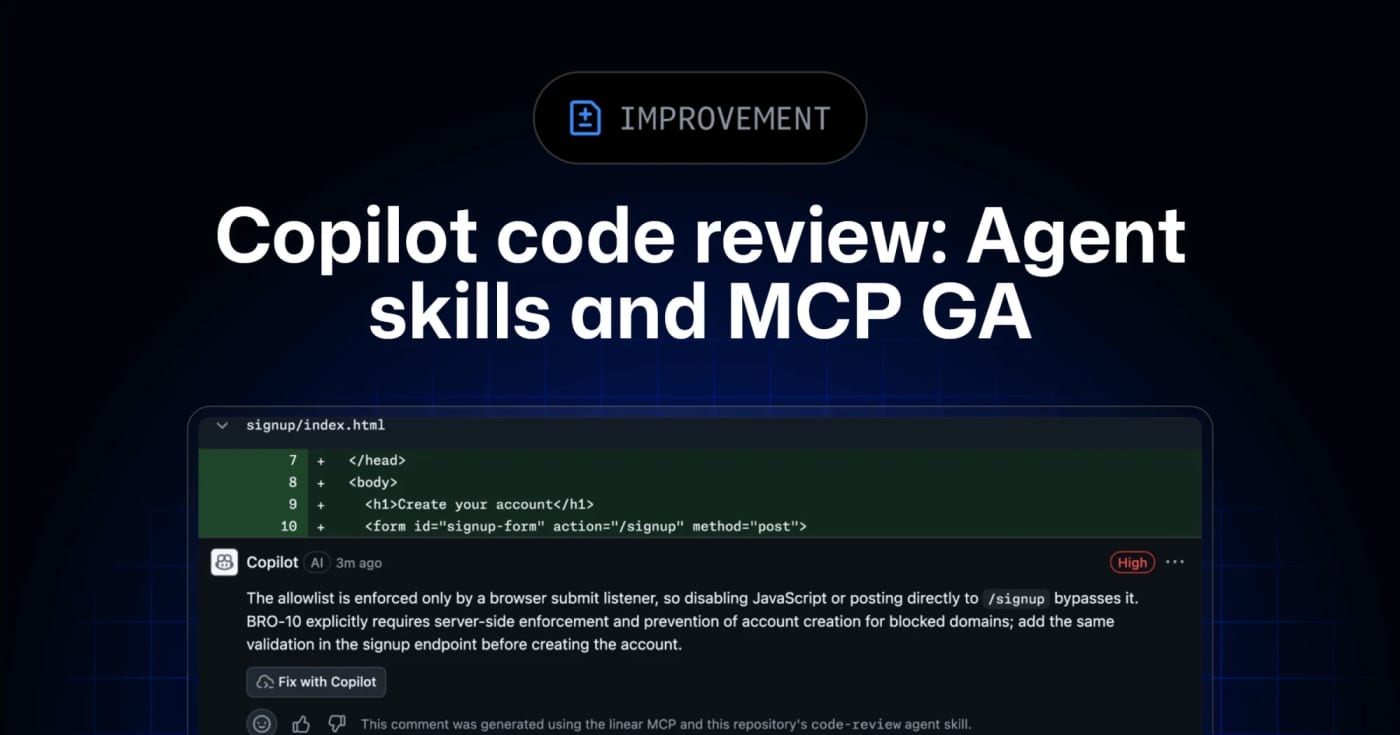
Let Copilot code review use repo skills and MCP context

0
GitHub’s Copilot code review can now use repository agent skills and read-only MCP servers, giving teams a practical way to inject standards and project context into automated reviews. GitHub has moved agent skills and MCP support for Copilot code review to general availability across Copilot Pro, Pro+, Business, and Enterprise. What it is Copilot code review can now use repository-level agent skills and MCP server context when reviewing pull requests. Skills live under .github/skills with a SKILL.md file, while MCP servers can bring in read-only context from tools such as issue trackers, docs systems, service catalogs, or incident systems. Who it helps This is useful for engineering teams that already rely on internal review checklists, service ownership rules, security conventions, or issue metadata. Instead of hoping a generic reviewer catches local standards, teams can encode focused instructions and let Copilot reference external context during review. How to evaluate it Start with one narrow skill, such as API compatibility, migration checks, or test expectations for a specific package. Keep the first MCP connection read-only and low-risk, then inspect whether Copilot’s comments clearly attribute skill or MCP usage. For Business and Enterprise environments, check policy controls and billing behavior before enabling automatic reviews broadly. Limits and risks Copilot code review is still advisory. GitHub’s docs warn that it can miss issues or make mistakes, and human review remains required. MCP tool calls for code review are read-only, but teams should still audit what context each server exposes. Medium review effort and agentic capabilities can also consume more AI credits and GitHub Actions minutes. Sources GitHub changelog announcement GitHub Docs: Copilot code review
Free
Review open
0

Use code-review-graph to give coding agents targeted review context

0
code-review-graph is an MIT-licensed MCP and CLI tool that builds a local structural map of a repository so coding agents can review changes with narrower, more relevant context. code-review-graph is a practical add-on for teams that ask Codex, Claude Code, Cursor, Gemini CLI, or similar assistants to review real repositories. Instead of making the model reread broad chunks of the codebase, it builds a local Tree-sitter-backed graph of functions, classes, imports, calls, tests, and affected flows, then exposes targeted context through MCP and CLI commands. The useful part is that it is local-first and installable today from PyPI. The project documents one-command setup, platform-specific install targets, incremental updates, broad language coverage, and a GitHub Action that can post risk-scored pull request comments. That makes it worth testing in larger repos where review prompts waste tokens or miss the actual blast radius of a change. Caveats: treat the benchmark claims as project-reported until you reproduce them on your own codebase, and review the generated MCP/editor configuration before enabling it across a team. The current PyPI and GitHub release checked for this Loot is v2.3.7, published July 18, 2026, with Python 3.10+ required.
Free
Review open
0

Run Copilot security reviews before code leaves your branch

0
GitHub's Copilot app now exposes a /security-review command in public preview for scanning in-flight code changes. GitHub has added a /security-review slash command to the GitHub Copilot app, extending the security-focused review flow beyond the earlier Copilot CLI preview. Use it as a pre-PR or pre-merge check when a branch includes authentication, file upload, payment, dependency, or permission changes. What to try: Open a project in the Copilot app. Make or load the code changes you want reviewed. Run /security-review and inspect the findings before you create or merge a pull request. Keep normal SAST, dependency scanning, secret scanning, and human review in place. Limits to remember: GitHub labels the app command as public preview. Copilot code review availability depends on plan and organization policy. AI review can miss issues, especially in framework-specific flows or code paths that need runtime context. Treat findings as triage input, not as a release gate by itself.
Free
Review open
0

Use Cloudflare Mythos to Find Real Codebase Bugs with AI Agents

0
A practical defensive guide for checking your own codebase with AI agents: narrow scopes, parallel hunts, adversarial validation, reachability tracing, dedupe, gapfill, and governance gates. Built from the core operational lessons in Cloudflare's Project Glasswing write-up.
29
Review open
0
Blog

Related reads

Browse blog
Tools & Apps

GitHub puts Copilot code review behind a default firewall

GitHub now gives Copilot code review its own firewall, setup workflow, and runner configuration, separating review-agent controls from the b

Tools & Apps

Check GitHub Code Quality costs before July 20 billing starts

GitHub now shows a Code Quality license estimate before the product becomes paid on July 20, 2026. Teams should check active committers, Act

Tools & Apps

Use GitHub's new pulls dashboard to stop losing review work

GitHub's refreshed pull requests dashboard is now generally available, giving developers and managers one place for review requests, CI fail

Tools & Apps

Lock Down GitHub Review Dismissals Before a Bad Merge Clears Approval

GitHub now lets repository rulesets restrict exactly who can dismiss pull request reviews, giving teams tighter control over approvals befor

Wissen & Lernen

A practical rule for AI code review: reject working diffs you cannot explain

A June 2026 developer essay and active Hacker News discussion point to a recurring coding-agent problem: green CI is not enough when the rev

Tools & Apps

Ponytail turns YAGNI into an agent skill with real GitHub momentum

Ponytail is a fast-rising GitHub project that packages minimalist engineering heuristics for coding agents across Claude Code, Codex, Copilo

AI & Automation

GitHub Copilot code review now reads AGENTS.md

GitHub Copilot code review can now use a repository-level AGENTS.md file, giving teams a direct way to shape automated pull request feedback

Business & Karriere

GitHub Copilot code review adds org runners, content exclusions, and longer instructions

GitHub added governance controls for Copilot code review: organization-level runner defaults, content exclusion support, and no 4,000-charac

Tools & Apps

Hugging Face Serge puts AI code review inside GitHub pull requests

Hugging Face released Serge, an open-source GitHub-native AI code reviewer that follows repository-owned review rules and works with OpenAI-

Business & Karriere

Coding agents are making review judgment the new SDLC bottleneck

Stack Overflow's latest analysis argues that coding agents shift the pressure from writing code to reviewing, coordinating, and deciding wha

AI & Automation

Cloudflare Mythos lesson: stop asking one agent to scan your whole codebase

Cloudflare's Project Glasswing write-up is not just about Mythos chaining exploits. The bigger lesson is how to structure AI agents for real