Topic

#creator tools

Loot, blog posts and adjacent themes connected to this topic. Follow the tag to keep it in your orbit.

#creator tools
Loot

More from this topic

Explore all loot
Edit AI-assisted videos locally on Mac with Palmier Pro

Edit AI-assisted videos locally on Mac with Palmier Pro

0
Palmier Pro is a free macOS video editor with an open-source timeline, MCP support for coding agents, and paid generative AI features for creators who want agents inside the edit workflow. What it is Palmier Pro is a macOS video editor aimed at creators who want a conventional timeline plus an AI-agent surface. The public repository describes a Swift-native editor, a local MCP server, and integrations for Claude, Codex, Cursor, and Claude Desktop so an agent can work against the same editing project. The practical hook is the MCP bridge. When the app is open, the project exposes a local MCP endpoint so an agent can connect to the timeline workflow instead of treating the video editor as a black-box GUI task. Why it is useful Use this if you create short-form video, tutorials, product clips, or social edits and want to test what agent-assisted editing feels like without starting from a closed web-only tool. The repository ships a downloadable macOS DMG and the editor can be used without login for normal editing and MCP experiments. The generative AI side is not fully free: the README says video/image generation features require login and subscription. That makes Palmier Pro best viewed as a free editor and agent-integration testbed first, with paid AI generation as an optional layer. Setup surface The latest GitHub release observed for this run is v0.6.14, published on July 22, 2026, with a PalmierPro.dmg asset. The repository metadata reports GPL-3.0 licensing, but the README adds an important caveat: the editor, MCP server, and agent chat are open source, while generative AI processing is closed source. Platform support is narrow. The README states that Palmier Pro requires macOS 26 Tahoe on Apple Silicon, so Windows, Linux, Intel Mac, and older macOS users should skip it for now. Caveats before you try it Do not paste production API keys or private client media into a new editor workflow just because it has an agent interface. Review what the MCP server exposes, use disposable test projects first, and treat any agent/video-generation workflow as a privacy boundary until you know which data stays local and which data goes to external model providers. The install path includes a DMG download and the README also documents agent connection snippets. Review the release asset, permissions, network behavior, and MCP tools before connecting a real coding-agent workspace. Source links Palmier Pro GitHub repository: https://github.com/palmier-io/palmier-pro Palmier Pro v0.6.14 release: https://github.com/palmier-io/palmier-pro/releases/tag/v0.6.14 Show HN discussion: https://news.ycombinator.com/item?id=49022911 Palmier website: https://palmier.io
Free
Review open
0
Control Audacity from MCP clients with Audacity-MCP

Control Audacity from MCP clients with Audacity-MCP

0
A local MCP server that lets compatible AI clients drive Audacity audio-editing workflows through Audacity's scripting interface. Audacity-MCP is a practical bridge for creators who already edit in Audacity and want an MCP-compatible assistant to help with repeatable audio work. The project packages a Python MCP server for Audacity via mod-script-pipe, so the useful angle is not another cloud audio editor; it is local control of an existing desktop editor from clients that can speak MCP. Use it when you want to experiment with assistant-driven podcast cleanup, voiceover editing, transcription labels, export steps, or mastering prep while keeping the audio workflow anchored in Audacity. The PyPI package currently lists audacity-mcp as a beta Python package for AI-driven audio editing via mod-script-pipe and requires Python 3.10 or newer. Evaluation notes before using it in production: Treat it as a beta tool and test on copied project files first. Audacity must support the scripting path the tool relies on; check Audacity's own scripting documentation before setup. Review the install scripts and dependencies before running them on a creator workstation. Do not assume the assistant's audio choices are final; keep human listening and export QA in the loop. Good fit: podcasters, video editors, musicians, and automation builders who want to turn repeated Audacity actions into promptable local workflows without uploading raw audio to a hosted editor.
Free
Review open
0
Export editable Word documents from semantic HTML with DOM-docx

Export editable Word documents from semantic HTML with DOM-docx

0
DOM-docx converts semantic HTML fragments into native, editable .docx files, giving builders a lighter path for report exports, invoices, and creator documents than screenshot-style rendering. DOM-docx is a small MIT-licensed JavaScript library and CLI for turning semantic HTML fragments into native Word documents. It is useful when a product already renders reports, briefs, invoices, tables, or creator drafts as HTML but still needs a real .docx export that users can edit in Word. The default path is intentionally lightweight: inline styles convert in pure JavaScript, with no browser or Playwright dependency for normal Node usage. If you need class-based or computed CSS, the project supports an optional computed-style path using Playwright and Chromium. For browser apps, the package also exposes a browser bundle that can create a Blob in the user's tab. What makes this worth bookmarking is the practical scope. The project supports headings, paragraphs, lists, tables, links, inline formatting, simple SVG, page metadata, headers, footers, page numbers, and image handling through an explicit resolver. It also documents the limits clearly: external stylesheets on the inline path, complex layout, web fonts, forms, and guaranteed multi-page fidelity are not solved yet. Best fit SaaS report exports where HTML is already the source of truth. Internal tools that need editable Word handoff instead of PDF-only output. Creator workflows that generate briefs, scripts, proposals, or tables from templates. Agent-generated documents where a semantic HTML intermediate is easier to inspect than OOXML. Caveats before shipping Treat untrusted HTML as input data and sanitize it before conversion. Use an allowlisted imageResolver for remote images, because the library does not fetch remote images by default. Test real customer documents in Word and LibreOffice before promising layout fidelity. Use the computed-style path only when you actually need stylesheet or class resolution.
Free
Review open
0
Edit agent-made videos through a JSON timeline with FableCut

Edit agent-made videos through a JSON timeline with FableCut

0
FableCut is an open-source browser video editor built around a JSON timeline, MCP/REST control, and live reload so coding agents can assemble edits without driving a conventional GUI. FableCut is a small open-source video editor for teams experimenting with agent-driven media workflows. The useful idea is simple: the project timeline lives as JSON, the editor live-reloads when that file changes, and agents can work through MCP or REST instead of trying to click through a traditional nonlinear editor. Use it when you want to prototype short videos, product clips, narrated demos, or social edits where an agent can plan the structure and update the timeline directly. It is especially interesting for creators who already use coding agents and want video editing to become a file-based workflow. What to check Confirm the repo license and setup steps before using it in commercial work. Test with disposable media first, especially if an agent can edit local project files. Check the export path and whether your workflow needs server-side ffmpeg or browser-side rendering. Keep brand assets, client footage, and credentials outside any folder an autonomous agent can modify. Source check Confirmed by the GitHub repository: FableCut describes itself as a zero-dependency browser video editor with a JSON timeline, MCP/REST controls, and a live-reloading UI. Hacker News is useful context for community interest and early limitations, not the primary source.
Free
Review open
0
Turn dense 3D scans into clean quad topology with AutoRemesher

Turn dense 3D scans into clean quad topology with AutoRemesher

0
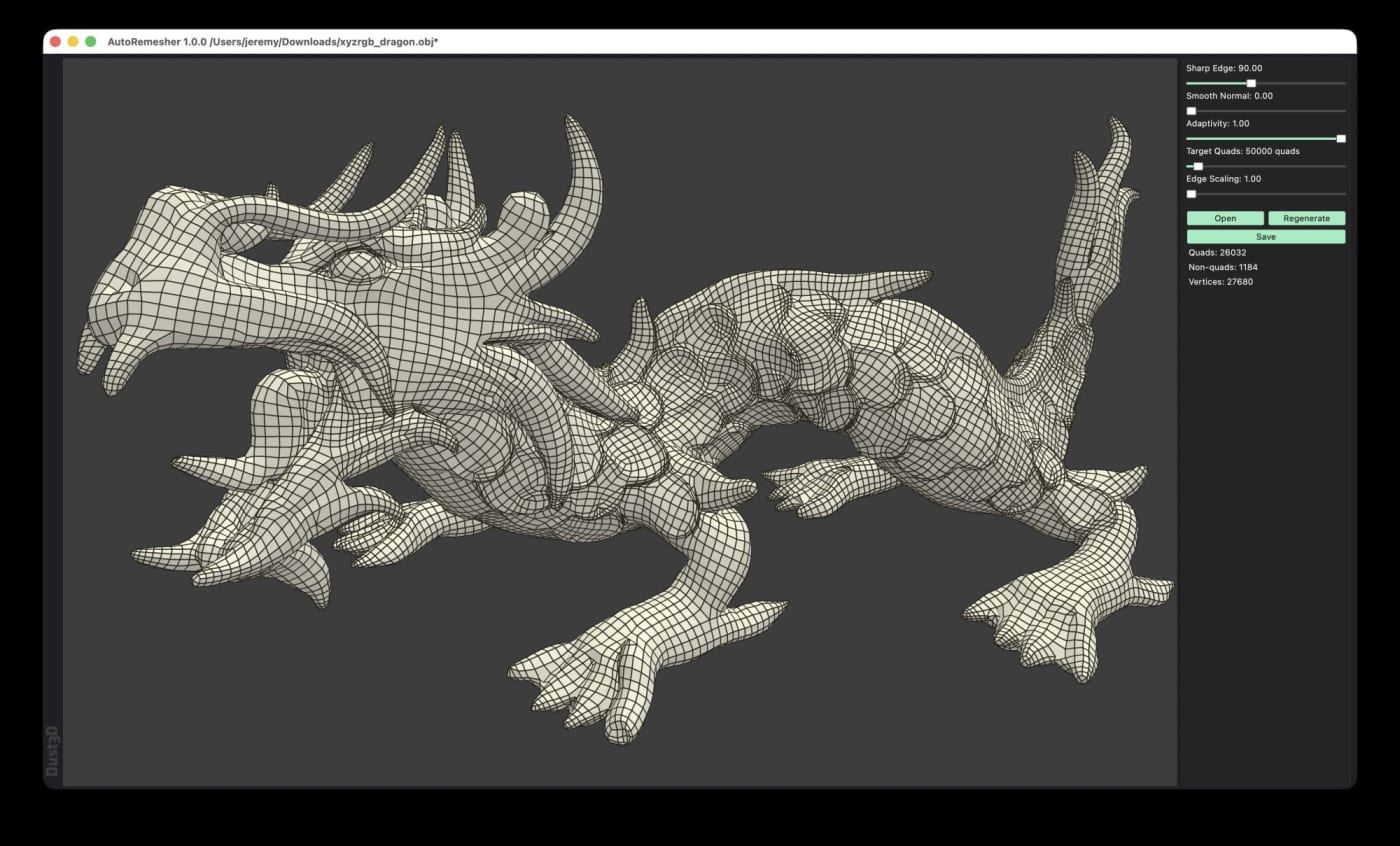
AutoRemesher is an MIT-licensed, cross-platform automatic quad remeshing tool for converting high-polygon meshes into cleaner quad-based topology. The July 2026 1.0.0 release adds ready-to-download Windows, Linux, and macOS builds, a command-line mode, and practical controls such as target quads, sharp edge, adaptivity, and smooth normal settings. AutoRemesher is worth saving if you work with dense scans, sculpted meshes, kitbashed models, or experimental 3D assets that need cleaner quad topology before editing, rigging, or downstream optimization. It is a standalone open-source remeshing tool rather than a Blender-only addon, and the current release includes binaries for Windows, Linux, and macOS. What it does AutoRemesher converts high-polygon input meshes into quad-based output. The project README describes it as a cross-platform automatic quad remeshing tool built on Geogram, libigl, isotropic remesher, and related geometry libraries. The 1.0.0 release is especially useful because it moved to an MIT license, added a command-line interface, improved remeshing and quad extraction algorithms, and exposed controls for target quads, adaptivity, sharp edges, edge scaling, and low-poly smooth normals. Why it is useful Free and open source under the MIT license Runs on Windows, macOS, and Linux Provides release binaries, including AppImage and DMG builds Supports GUI use and headless CLI processing Targets practical retopology jobs for dense meshes and 3D scan cleanup Lets you tune the result with target quads and edge/sharpness settings Quick way to evaluate it Download the 1.0.0 build for your platform from GitHub Releases. Run one dense OBJ test mesh through the GUI. Repeat the same file with CLI mode and a fixed --target-quads value. Inspect edge flow, holes, sharp edge preservation, and UV/material needs in your 3D tool. Keep the command settings that produce acceptable topology for your asset type. Practical LinkLoot angle This is a strong utility pick for 3D creators because it can sit between messy source geometry and heavier tools like Blender, Maya, Cinema 4D, or game-engine import pipelines. The CLI mode also makes it interesting for batch cleanup workflows where you want consistent mesh budgets across many assets. The caveat is the usual one for automatic retopology: it can save time, but it does not replace manual edge-flow decisions for animation-critical faces, hands, joints, or hero assets. Treat it as a first-pass topology tool, then do artist review where the model has to deform or render close up. Source check The GitHub repository lists AutoRemesher as an automatic quad remeshing tool with an MIT license, C++ codebase, and nearly 1,900 stars at the time checked. The 1.0.0 release notes confirm the July 2026 release, MIT relicensing, CLI mode, downloadable platform builds, and the new remeshing controls.
Free
Review open
0
Blog

Related reads

Browse blog