Topic
#self-hosted
Loot, blog posts and adjacent themes connected to this topic. Follow the tag to keep it in your orbit.
3Shown loot
1Shown articles
8Linked neighbor tags
Topic paths
If you want to go deeper, the adjacent tags are the fastest way to compare and branch into related workflows.
Loot
More from this topic
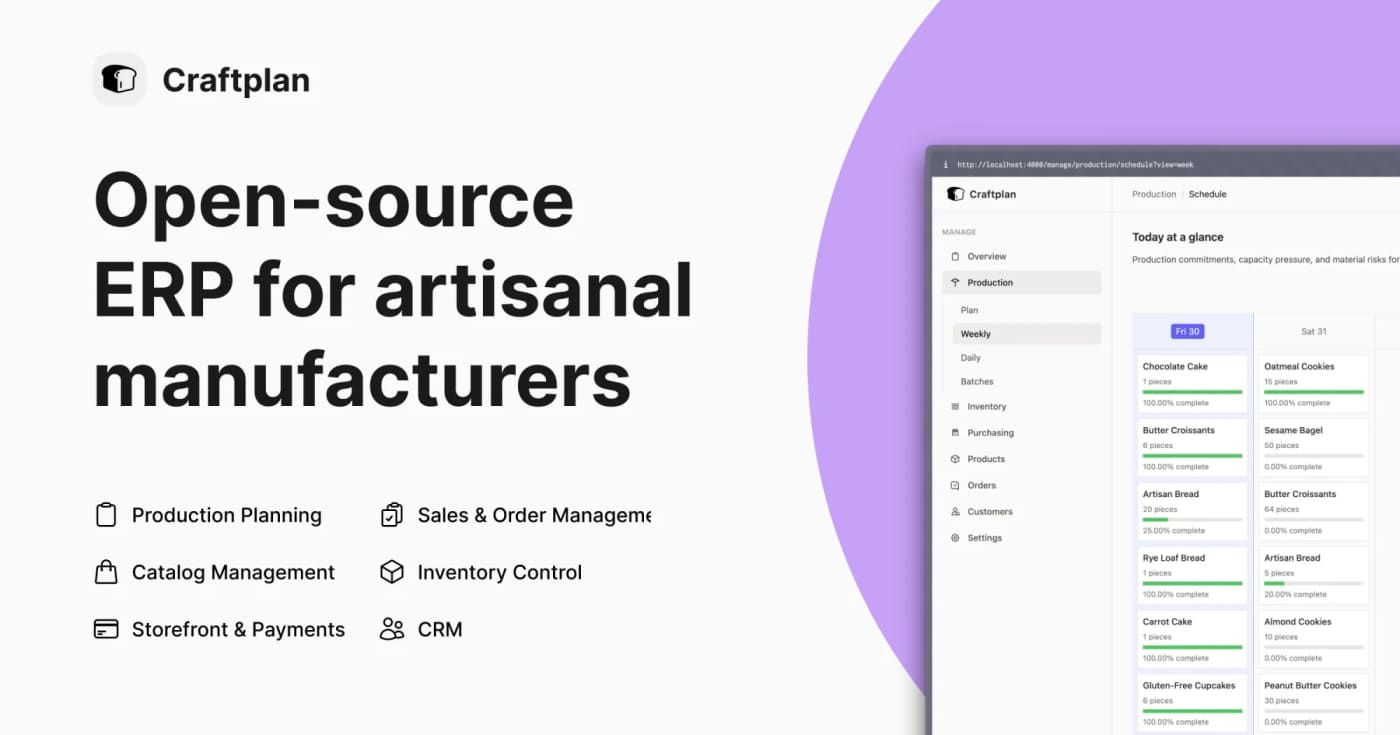
Craftplan is an AGPL-licensed ERP for small artisanal manufacturers that bundles catalog, inventory, orders, production planning, purchasing, CRM, API access, and CSV import/export into one self-hosted Phoenix app. Craftplan is worth bookmarking if you help small makers, bakeries, food producers, or other craft businesses escape spreadsheet-driven operations without buying a full enterprise ERP. The project is open source under AGPL-3.0 and is built around small-batch, made-to-order workflows instead of generic inventory tables. The practical value is the breadth: versioned bills of materials with cost rollups, order scheduling, production batches, raw-material inventory, lot traceability, allergen and nutrition tracking, purchase orders, customer/supplier records, CSV import/export, iCal feeds, and JSON:API plus GraphQL endpoints. That makes it useful both as deployable software and as a reference implementation for vertical SaaS builders. Caveats: it is self-hosted, so expect Docker/server administration, secrets setup, backups, and operational ownership. The latest GitHub release checked for this Loot is v0.5.0 from June 23, 2026, so treat it as promising open-source infrastructure rather than a mature turnkey SaaS.
Free
Review open


Omni is a self-hosted workplace search and agent layer that indexes tools like Google Workspace, Slack, Jira, Confluence, HubSpot, and local files with Postgres, ParadeDB, and pgvector. Omni is a useful find for teams that want Glean-style workplace search without sending every knowledge source into a closed SaaS stack. The project connects to common work tools, builds a shared context layer, and gives agents search, citation, and tool-use paths over company data. Best fit: technical teams that can self-host Docker services, already run Postgres, and want to test hybrid BM25 plus vector search before buying an enterprise search platform. What to check before using it: Confirm the connectors you need are production-ready, especially Microsoft 365, Notion, GitHub, or custom internal systems. Review permission inheritance against your own identity model before indexing private content. Decide whether your LLM provider keeps data inside your boundary; self-hosting the index does not automatically make hosted model calls private. Test Postgres, ParadeDB, and pgvector performance on a realistic document count. Treat the project as beta unless your own deployment test proves it can handle your security and uptime requirements. Area Omni angle Verification check --- --- --- Search BM25 plus vector search in Postgres Test recall against your real docs Agents Chat and tool use over indexed company data Review sandbox and permissions Hosting Self-hosted deployment path Validate backups, auth, and updates Lock-in Apache-2.0 repository Confirm license and active maintenance This is a tool to trial, not a blanket recommendation. Start with a small workspace, index non-sensitive sources first, and compare answer quality, latency, and review burden against your current internal search or RAG setup.
Free
Review open
Paca is an open-source Jira/Trello alternative built for teams where humans and AI agents plan, pick up work, write specs, and ship from the same Scrum board. Paca is a self-hosted project management platform for teams that want AI agents to work inside the normal delivery loop instead of sitting beside it as chat widgets. It gives agents and humans the same board, sprint context, task flow, docs, and real-time updates. Why this is worth saving AI agents can be assigned to sprints and appear on the Scrumban board with human teammates. The project includes MCP support, so compatible AI tools can access projects, tasks, sprints, documents, members, comments, attachments, and plugin tools through a structured interface. Teams can customize workflows, statuses, fields, board layouts, sprint rules, and agent behavior through configuration. Plugins extend the system with WASM backend modules and frontend modules, with capability-style permissions. It is Apache-2.0, self-hosted, and currently packaged with install assets through GitHub Releases. Fast workflow Star or watch the repo so you can track the fast release pace. Spin it up in a disposable test environment first, not production. Connect one MCP-compatible assistant to a test project. Create a small sprint with low-risk tasks and ask the agent to update status through Paca instead of chat. Review the activity diff and task history before letting agents touch larger workstreams. What to test first Area What to check Why it matters :--:--:-- MCP server Project/task/sprint tool access Determines whether your agent stack can use Paca as a real operating layer Scrumban board Human and agent task movement Shows whether the workflow feels natural for mixed teams Plugin model WASM/backend and frontend extension paths Useful if your team needs custom process logic Deployment Docker Compose and release assets Confirms whether self-hosting fits your infrastructure Security posture API keys, sandboxed agents, permissions Required before bringing real company data into the system Caveat This is a young, fast-moving project. Treat it as promising infrastructure to evaluate, not a drop-in replacement for an enterprise Jira setup yet. Run a sandbox pilot, read the deployment files, and verify the MCP/API permission model against your own security requirements. Source check GitHub repo confirms Apache-2.0 licensing, self-hosted positioning, MCP support, OpenHands-powered agents, WASM plugins, and current project stats. The official website confirms the product positioning: humans and AI agents working on one Scrum team. The latest GitHub release confirms active release packaging, including Docker Compose, gateway config, and install script assets.
Free
Review open
Blog